
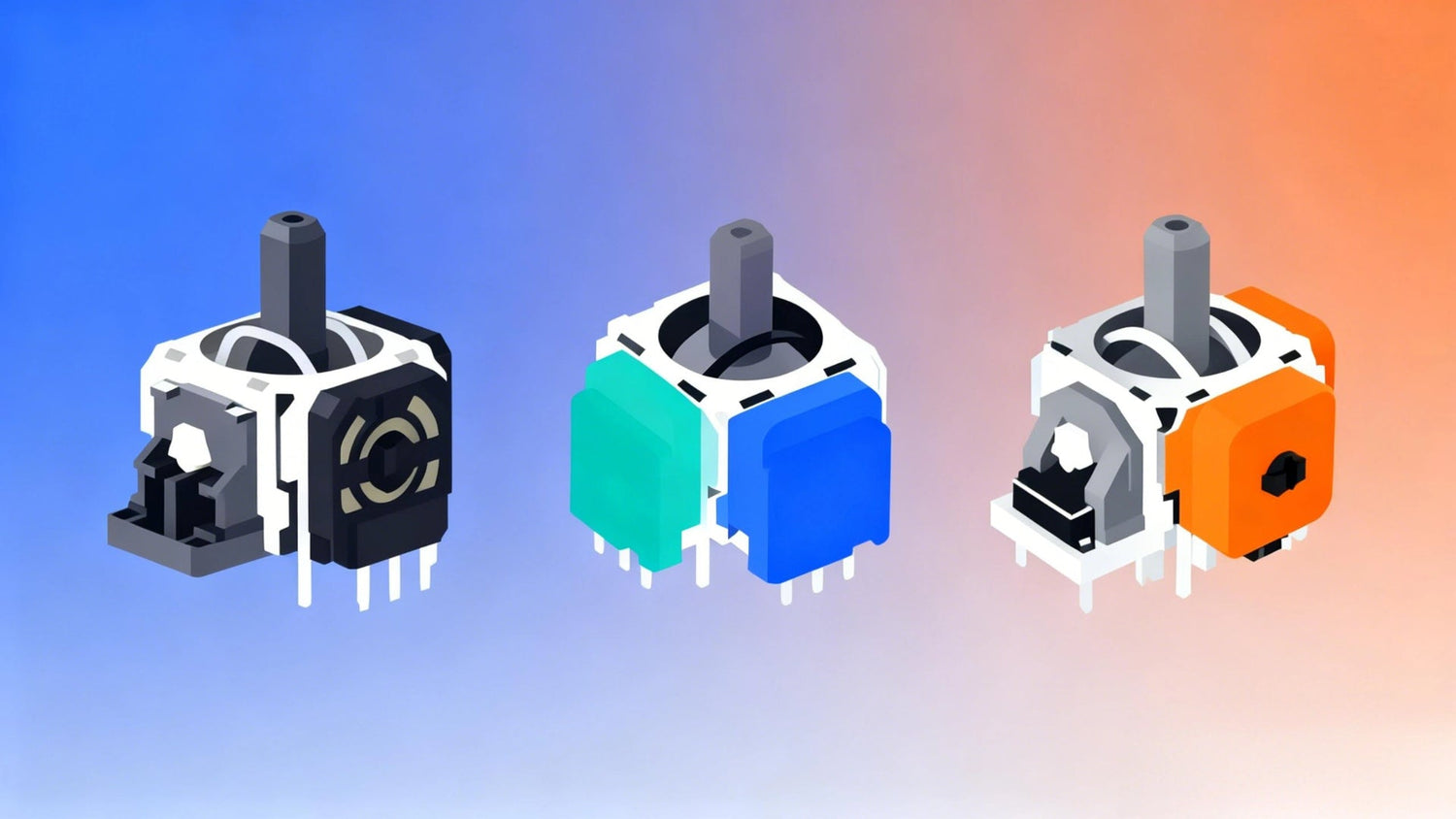
Why Analog Stick Technology Matters More Than You Think (ALPS vs Hall Effect vs TMR)?

This guide conducts a definitive showdown between the standard technology, the first magnetic solution, and the latest high-fidelity evolution, analyzing technical data to determine which stick architecture provides optimal raw aiming performance and consistency in a complete controller package.
1. The Analog Stick Problem: Why ALPS Fails
The standard potentiometers, known as ALPS, are found in nearly every major first-party controller and are considered the baseline. Their flaw is fundamental: they rely on Resistive Contact.
As you move the stick, a metal wiper physically drags across a curved carbon track. This friction causes the carbon track to wear down over time, creating conductive dust and "dead spots," which is the root cause of stick drift. This mechanical system is fundamentally designed for inevitable failure.
2. Deep Dive: Potentiometers vs. Hall Effect vs. TMR
Understanding the core technology is crucial, as not all magnetic sticks are created equal.

1. Potentiometers (ALPS): The Wear-and-Tear Standard
Technology: Resistive Contact.
Flaw Summary: Physical friction creates wear and dust, leading to inevitable drift.
Reference Data: Standard ALPS sticks operate at approximately 60gf (gram-force) of tension.
2. Hall Effect (HE): The First Drift-Proof Solution
Technology: Magnetic Field Strength.
How it Works: A sensor measures the magnetic field strength of a magnet placed on the moving shaft. Since there is no physical contact, there is zero mechanical wear.
The Performance Caveat: Standard Hall Effect sensors can be "noisy." To process this, controllers often apply heavy software filtering, which can introduce latency or a "mushy" feel. Consequently, labeling a stick as "Hall Effect" is not an automatic guarantee of high performance—it requires expert implementation.
3. TMR (Tunnel Magnetoresistance): The High-Fidelity Evolution
Technology: Tunnel Magnetoresistance.
How it Works: TMR sensors measure a quantum effect—the resistance of electrons tunneling through a barrier—which changes drastically in the presence of a magnetic field.
Benefit: TMR is significantly more sensitive than Hall Effect, providing a raw, immediate signal. Because the signal is clean, it requires far less software filtering, resulting in input that feels crisper and lower latency, while remaining completely immune to mechanical drift.
3. Performance Benchmark: The Need for Sub-5ms Input
For competitive play, players need sticks that offer both high durability and high precision (low latency and consistent linearity).
Independent testing of aftermarket TMR modules has set a clear standard, demonstrating that superior mechanical design provides tangibly smoother aiming compared to budget solutions. However, the greatest performance advantage comes when advanced magnetic stick hardware is integrated into a complete, high-speed controller package. This ensures the clean signal from the stick is matched by the controller's rapid processing speed.
Leading third-party controllers are now setting a new benchmark: sub-5ms stick latency. This ultra-low input lag, combined with a high 12-bit resolution, places elite controllers in a category that provides effectively instantaneous response in competitive scenarios.
4. Market Leaders: Top Picks for Every Stick Technology
Choosing the right controller means balancing raw technology with the features that fit your playstyle. Here are the top representatives for each category.

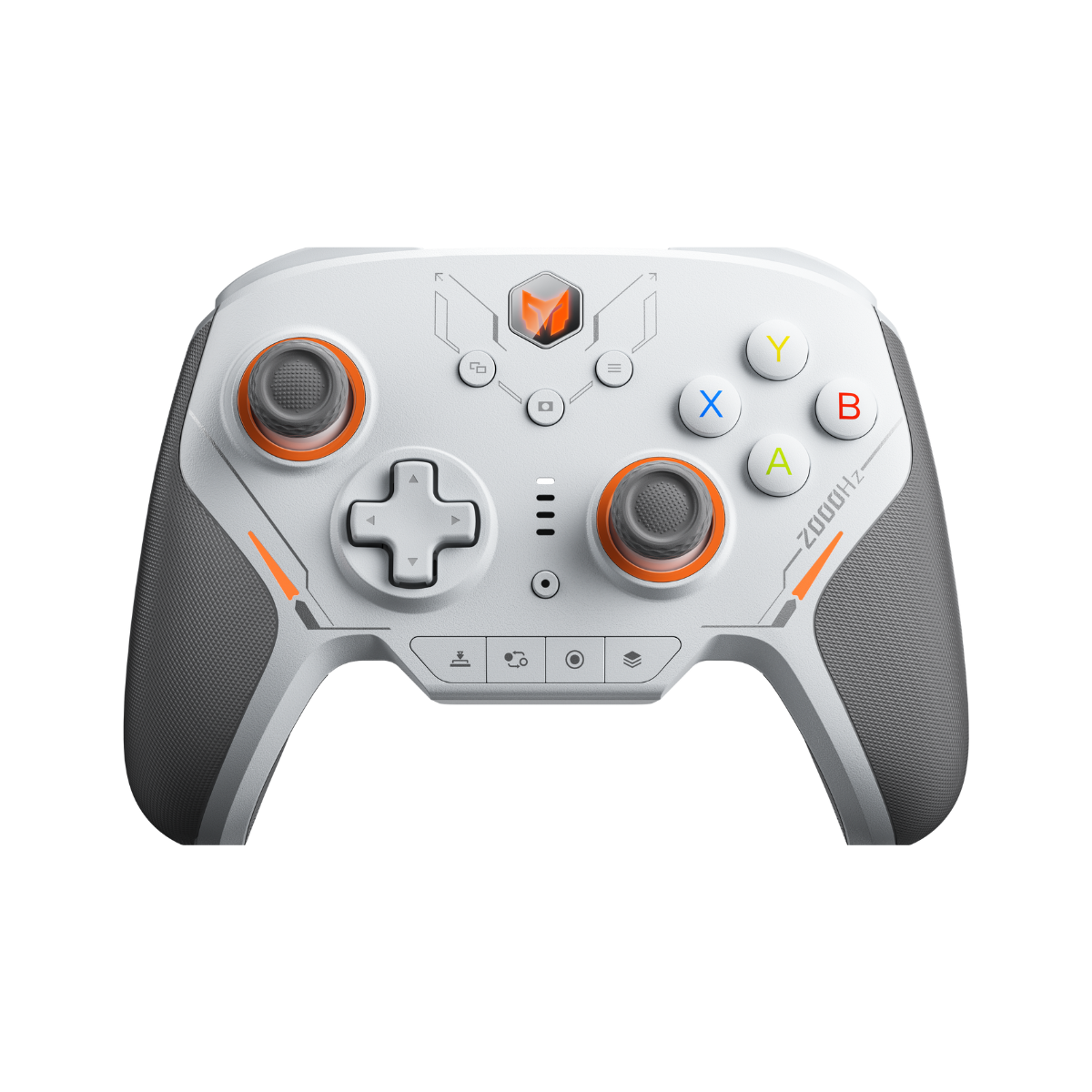
BIGBIG WON Blitz 2
Why it wins: For players seeking the "High-Fidelity Evolution," the Blitz 2 is the current benchmark. It utilizes TMR sensors to deliver raw, ultra-sensitive input that feels incredibly sharp and unfiltered.
Performance: Features a 2000Hz polling rate and near-zero stick noise.
Best For: Twitch shooters and competitive FPS players who want the most responsive, high-resolution aim possible.

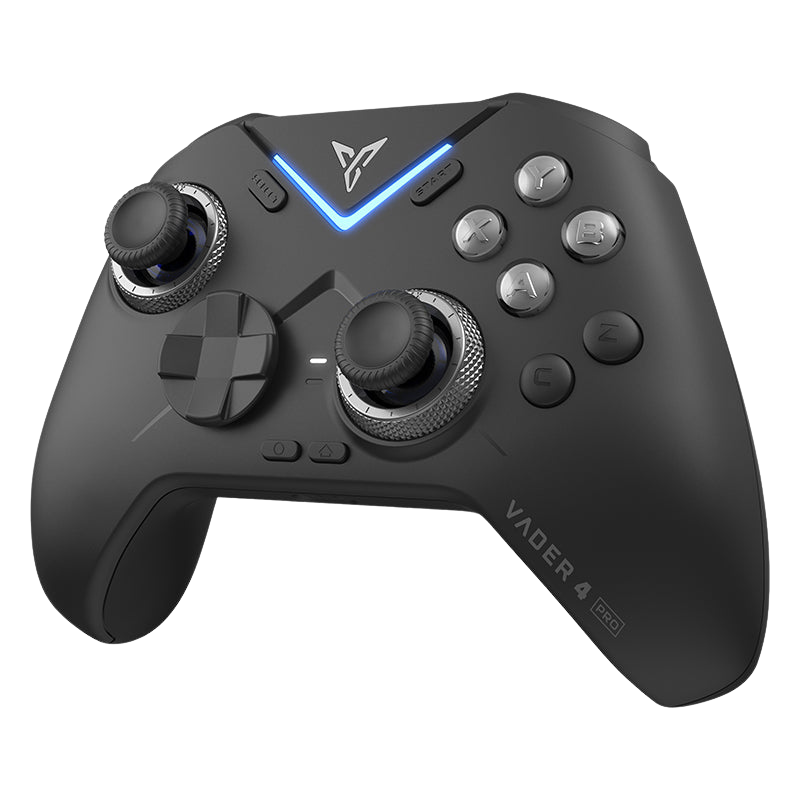
Flydigi Vader 5 Pro
Why it wins: While TMR focuses on sensitivity, the Vader 5 Pro focuses on Control. It solves the "loose" feeling of magnetic sticks with its Forceflex system, allowing users to mechanically adjust stick tension from 40gf to 100gf.
Performance: Validated sub-4ms stick latency and 12-bit resolution.
Best For: Players who want a "do-it-all" controller. You can tighten the stick for precision sniping or loosen it for fast-paced movement.

Sony DualSense
Analysis: The DualSense is the reference point for ergonomics and haptics. However, it relies on standard ALPS sticks.
Verdict: Excellent for casual PS5 gaming and cinematic experiences, but for competitive PC users, the inevitable risk of stick drift makes it a shorter-term investment compared to magnetic options.
(Note: This model is a performance reference and is available at major electronics retailers.)
5. Conclusion & Outlook
The transition away from potentiometers to magnetic technology (TMR and optimized Hall Effect) is essential for anyone seeking reliable, high-fidelity input.
Choose TMR (Blitz 2) if you want the rawest, most sensitive input possible and trust your micro-adjustment skills.
Choose Optimized Hall Effect (Vader 5 Pro) if you want a complete package that allows you to mechanically tune physical resistance to match your game.
For the serious gamer in 2026, the question is no longer "Will it drift?" but rather "How precisely can I tune my aim?"


コメントを書く
全てのコメントは、掲載前にモデレートされます
このサイトはhCaptchaによって保護されており、hCaptchaプライバシーポリシーおよび利用規約が適用されます。