





























What's Actually Shaking Inside Your Controller? ERM vs LRA vs Voice Coil vs Maglev vs Piezo, Explained
Hey everyone — Ray from GadgetHyper here. One of the most common questions we get is some version of "why does the DualSense feel so much fancier than every other controller's rumble?"
The honest answer involves five different motor technologies, a speaker company, at least one physics lesson, and a few myths about "licensed = better." So here's a casual, no-engineering-degree-required tour of how controller vibration actually works — what each motor type is good at, what it's bad at, and the stuff spec sheets won't tell you.
Five motor schools: rotary ERM (strong, cheap, dumb), linear LRA (fast, precise, a bit weak), voice coil VCM (a tiny speaker — the current king of immersion), magnetic levitation and piezo (the future, not here yet).
But here's the twist: the motor is only half the story — tuning and game support decide what you actually feel.
The Old Workhorse

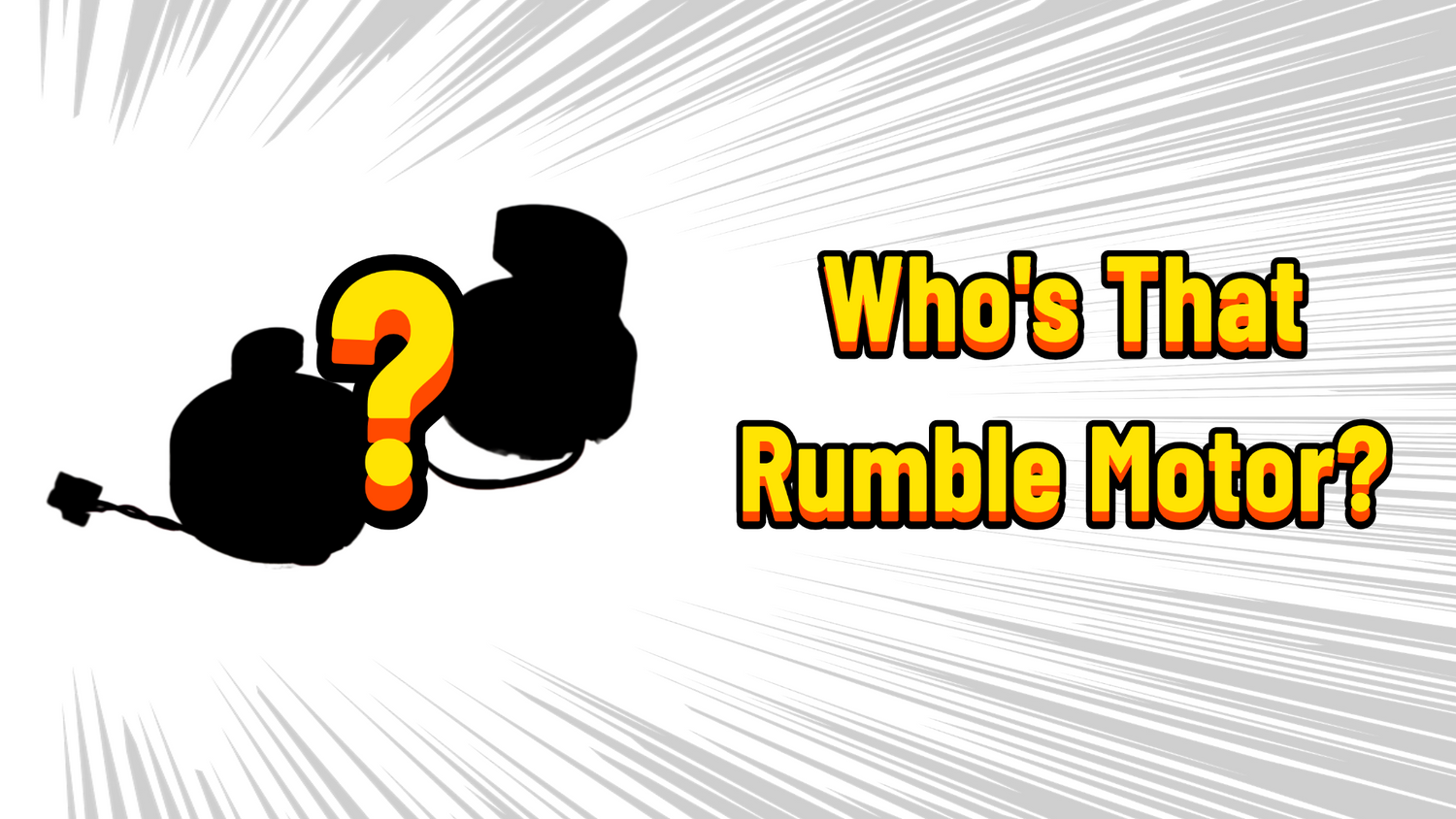
The classic. Inside, a small DC motor spins an off-center metal weight, and the centrifugal force of that spinning imbalance shakes the controller. The working principle is genuinely the same as a washing machine with all the clothes bunched on one side — or duct-taping a bent bit to a drill. Brute force, no finesse.
This is what roughly 70% of the market runs on, including every Xbox controller — Microsoft even tucks small ERMs into the triggers (that's what "Impulse Triggers" are). And credit where due: the full-hand, slightly-numbing roar an ERM makes when you're thundering across rough terrain in a racing game is something fancier motors still struggle to fake. It's strong, it's cheap, it's basically indestructible.
The weaknesses: it's a one-trick pony. Rumble strength is tied to spin speed, so intensity and frequency are fused onto a single knob — you can't have "strong but slow" or "gentle but fast," only "more" or "less." It's also slow to spin up and slow to stop (roughly 15–30ms), which makes short, sharp feedback — gunshots, footsteps, a sword parry — feel mushy and late.
What impressed me learning this: how much Microsoft squeezed out of such a crude device. Xbox controllers pair a big low-frequency motor on the left with a smaller, faster one on the right for finer textures, and they use quick start/stop circuitry — a brief voltage kick to get spinning instantly, and an H-bridge "brake" that dumps the momentum to stop cleanly. Same crude hardware, dramatically crisper result. Remember that sentence when we get to the tuning section.
The HD Rumble School

Stop spinning, start pistoning. An LRA packs a magnet, a coil, a mass, and a spring: energize the coil, the magnetic fields push the mass down the rail, the spring fires it back, and you get a tight little back-and-forth oscillation. If an ERM is a drill with a bent bit, an LRA is a mini massage gun hammering in one clean direction. Your phone's haptics work the same way.
This is the tech behind Nintendo's HD Rumble, and the first time I played the ice-cube-in-a-glass demo on Switch, it genuinely felt like sorcery — you could count individual cubes clinking around inside the controller. Compared to ERM, LRAs respond roughly 60% faster, start and stop on a dime, use less power, and can do direction and texture instead of just "shake."
The trade-offs: they're a specialist, not a bruiser — peak force is noticeably weaker, so big cinematic impacts lose some violence. And because it's a mass-on-a-spring resonant system, it only hits full strength inside a narrow frequency band (around 170–220Hz); drift outside that window and the rumble falls off a cliff. The springs also physically fatigue over years, so an old LRA gradually loses punch. Cost is 2–3x an ERM.
A Speaker That Plays Feelings

Here's my favorite fun fact in this whole article: the DualSense's haptic motors are made by Foster — a loudspeaker company. That's not a coincidence. A voice coil actuator IS a speaker, minus the cone: a coil moving a mass through a magnetic field, driven directly by current. And Sony uses it exactly like a speaker.
Two things make this a generational leap:
- It decouples frequency from intensity. An ERM has one knob; a VCM has two. Current direction and timing set the frequency, current size sets the amplitude — independently. That unlocks a claimed 5–1000Hz range, from a raindrop to an explosion, with sub-5ms response.
- It literally plays audio files. In games with native haptics, developers author actual waveforms — sometimes layers of frequencies stacked together — and the motor "plays" them. If you fed those waveforms to a speaker you'd hear noise; fed to the controller, they become rain on your palms, sand grit, the ting of a sword clash. The first time I felt individual raindrops in a game I just sat there squeezing the trigger like an idiot.
The catch is the asterisk of all asterisks: someone has to author those waveforms. Native haptics cost developers real time and money, so tons of cross-platform games fall back to a compatibility mode that just translates old-school "rumble intensity" commands — and the magic collapses back to decent-but-ordinary rumble. The hardware is also genuinely expensive (roughly 10–15x an ERM per motor). King of immersion, but only when the game shows up.
Maglev and Piezo

Two more worth knowing, quickly:
Magnetic levitation motors take the LRA idea and delete the spring: the moving mass floats in a magnetic field, so there's zero mechanical contact, zero wear, near-instant start/stop (under 5ms), and a 10–300Hz working band with impact that demos describe as "a punch instead of a push." People have demoed simulated heartbeats, sword-parry jolts, sniper recoil, even the clicky detents of a mechanical knob. Already in some VR gun stocks and creeping toward flagship controllers — currently expensive and mostly proprietary, but very much the one to watch.
Piezoelectric actuators skip magnetism entirely: apply voltage to a ceramic element and the material itself physically bends (the inverse piezoelectric effect). Response is sub-millisecond, precision is nanometer-scale, it sips power, and it's tiny. The catch: the force is far too weak for full-hand rumble, and it needs high-voltage drive circuitry. Its future is probably localized feedback — buttons, triggers, grips — not main rumble. Not a buying factor today.
The Part Spec Sheets Won't Tell You
This is the section that separates "reads marketing pages" from "actually knows," so lean in:
Tuning Sets the Experience
The motor sets the ceiling; tuning sets what you feel. "Rumble" is just frequency × amplitude, and what reaches your hands depends on PWM resolution — how many distinct intensity steps the controller can actually output. Well-tuned pads give you ~100 perceptibly different levels; badly-tuned ones give you "light buzz" and "angry buzz." Motor sizing and those quick start/stop circuits from the ERM section matter just as much.
"Licensed = Better Rumble" Is a Myth
Quick nerd-cred corner: XInput isn't even a protocol, it's an API. Under it, pads talk over HID, XUSB, or Microsoft's proprietary GIP depending on generation and connection. The API lets games ask for values from 0–65535, but the actual hardware might resolve 255 steps — or 100. What matters is how the driver and firmware translate the request into motor behavior, not the logo on the box. A well-tuned "old protocol" pad can match or beat an officially licensed one that phoned in the details.
The Game Is the Final Boss
Great haptics are like the aroma of food — you never consciously notice them, but take them away and everything feels wrong. The best motor in the world is a light tickle in a game that doesn't feed it properly (see: VCM compatibility mode). Platform matters too: Switch games natively support HD Rumble widely, so LRA pads shine brightest there.
A Nod to the Rumble-Off Crowd
A respectful nod to the FPS players who turned rumble off years ago for aim stability and never looked back — for you, this entire article is trivia night. That's fair.
The Five Schools, Side by Side
| Motor | Feel & Strength | Response | Wear | Cost | Found In |
|---|---|---|---|---|---|
| ERM | Strong, full-hand roar; one knob only | ~15–30ms spin-up/stop | Basically indestructible | Baseline (cheapest) | Xbox controllers, Impulse Triggers, ~70% of the market |
| LRA | Precise and textured; weaker peak force | ~60% faster than ERM | Springs fatigue over years | 2–3× ERM | Nintendo HD Rumble, phone haptics |
| VCM | Frequency and intensity decoupled; plays authored waveforms | Sub-5ms; 5–1000Hz range | No mechanical contact wear in the drive | ~10–15× ERM | DualSense (motors by Foster) |
| Maglev | "A punch instead of a push" | Under 5ms; 10–300Hz band | Zero mechanical contact | Expensive, proprietary | VR gun stocks; creeping toward flagships |
| Piezo | Ultra-precise, but too weak for full-hand rumble | Sub-millisecond | Solid-state | Needs high-voltage drive circuitry | Not in controllers yet |
So What Should You Actually Look For?
ERM
Cheap, durable, and still the king of raw violence-per-dollar.
LRA
Fast, detailed, balanced — especially strong if you play on Switch.
VCM
With one caveat: check whether the games you play actually support native haptics. The list on PC keeps growing.
Maglev & Piezo
Maglev: keep an eye on the flagship space over the next couple of years. Piezo: revisit in five years.
And whatever the motor: hybrid setups — different motors in grips vs triggers — are where everything is heading.
So, two questions for the comments. First: rumble ON or rumble OFF — where do you stand? And second: what's the single most impressive rumble moment you've ever felt in a game? The ice cubes and the raindrops are my picks. What are yours?





Leave a comment
All comments are moderated before being published.
This site is protected by hCaptcha and the hCaptcha Privacy Policy and Terms of Service apply.